
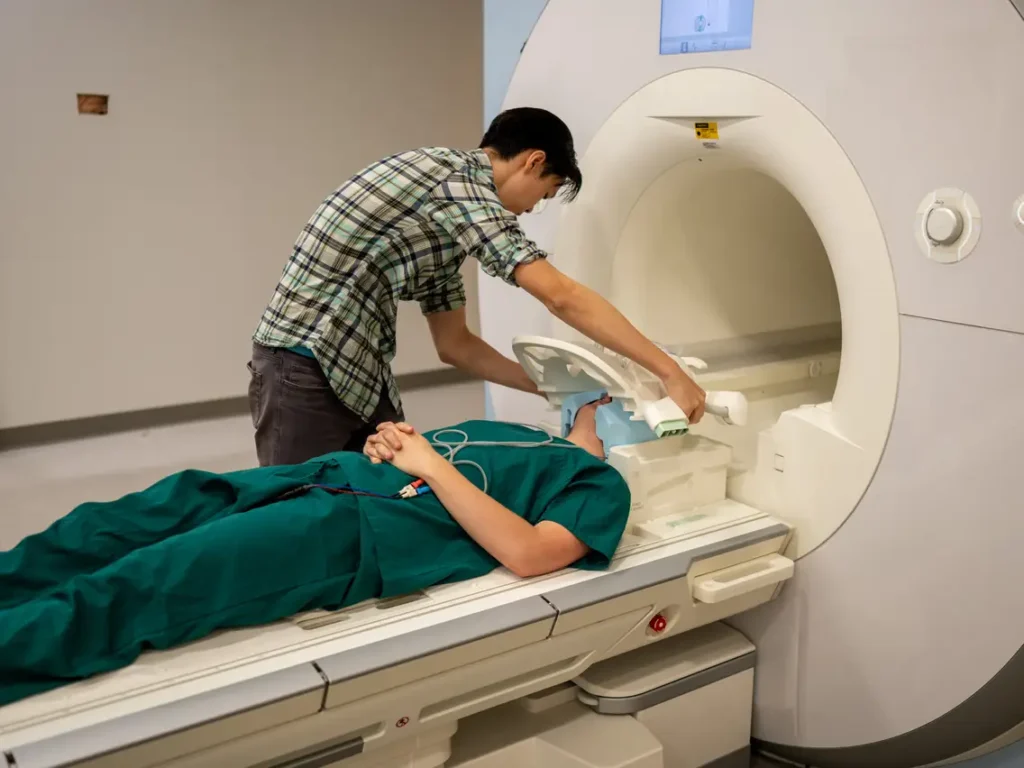
A team of researchers at the University of Texas at Austin has developed a groundbreaking AI system that can read people’s thoughts non-invasively. The system is based on a decoder that translates brain activity into a continuous stream of text, enabling researchers to reconstruct speech from functional magnetic resonance imaging (fMRI) scan data. This marks a major milestone in the field of neuroscience , opening up new possibilities that were previously thought impossible.
The research team, led by Professor Chang, worked on this project for six years and has now published their findings in the journal “Nature Neuroscience”. The decoder uses a machine learning algorithm that can predict the content of a person’s thoughts by analyzing the patterns of brain activity associated with language. This means that the decoder can translate brain signals into text in real-time, allowing researchers to reconstruct what a person is thinking and saying.
The system was tested on a group of people who listened to or silently imagined a story while undergoing an fMRI scan. The decoder was able to accurately reconstruct the words and sentences from the brain activity, allowing the researchers to read the participants’ thoughts with an accuracy of up to 97%. This is a remarkable achievement that could have far-reaching implications for a wide range of applications, from communication with patients who are unable to speak to more advanced brain-computer interfaces.
The researchers noted that the artificial system’s ability to reconstruct speech from brain activity could have a significant impact on the fields of neuroscience, psychology, and communication disorders. It could also have implications for developing new tools and technologies for people who are unable to communicate verbally, such as those with locked-in syndrome or severe speech impairments.
However, there are also concerns about the ethical implications of such technology, particularly around privacy and the potential for misuse. It is important to consider the possible consequences of such technology and to ensure that appropriate safeguards are in place to protect people’s privacy and autonomy.
Despite these concerns, the development of this system represents a significant breakthrough in the field of neuroscience and AI. The ability to read people’s thoughts non-invasively opens up new possibilities for understanding the brain and developing new tools and technologies that could transform people’s lives.
As with any new technology, it will be important to continue to monitor and study the artificial system’s potential applications and ethical implications. Nonetheless, the development of this system marks an exciting new chapter in the field of neuroscience, one that could ultimately lead to a deeper understanding of the human brain and new ways to help those who need it most.
In conclusion, the development of artificial system that can read people’s thoughts non-invasively is a major breakthrough in the field of neuroscience. The system’s ability to reconstruct speech from brain activity could have significant implications for a wide range of applications, from communication with patients who are unable to speak to more advanced brain-computer interfaces.
Read more: 7 human skills AI can never replace
Nonetheless, it is important to carefully consider the potential ethical implications of such technology and to ensure that appropriate safeguards are in place to protect people’s privacy and autonomy. The development of this system marks an exciting new chapter in the field of neuroscience and Artificial Intelligence, one that could ultimately lead to a deeper understanding of the human brain and new ways to help those who need it most.