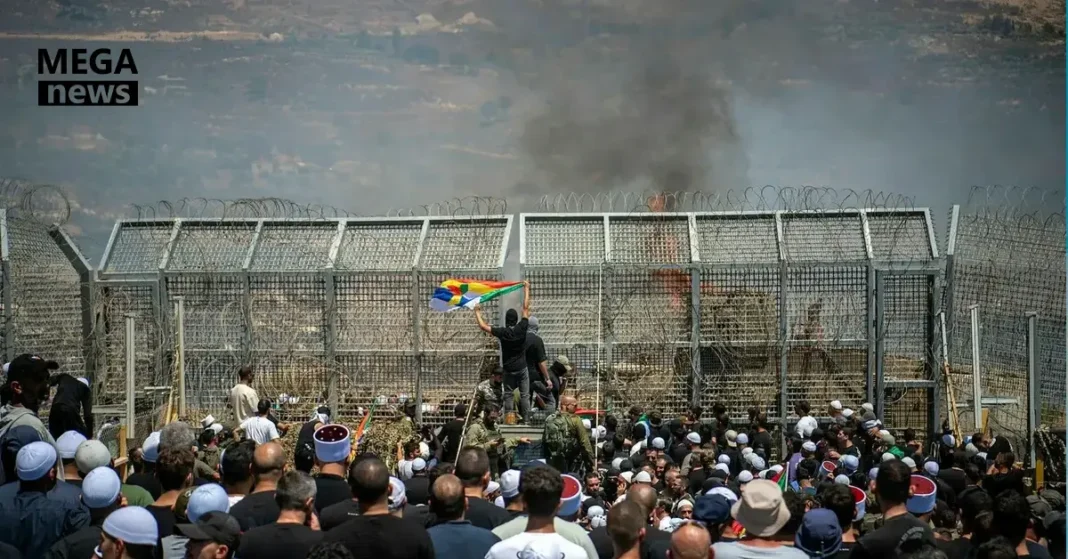
BEIRUT/JERUSALEM: Israel Syria Ceasefire Agreement reached to a temporary ceasefire following a brutal week of sectarian clashes in Syria’s southern Sweida province, which left over 300 people dead and hundreds more injured. The ceasefire, brokered with support from Turkey, Jordan, and regional actors, was confirmed on Friday by the U.S. envoy to Turkey.
The fighting, triggered by violent confrontations between Syrian government forces and local Druze fighters, had rapidly escalated in the southern region. The Israeli government confirmed that it had conducted airstrikes in Damascus and in Sweida earlier this week, citing the need to protect Syria’s Druze minority—a group with historical and religious ties to Israel’s own Druze population.
Ceasefire Terms: Limited Syrian Troop Access to Sweida
As part of the fragile Israel Syria ceasefire agreement, Israel has allowed limited access to Syrian internal security forces in the Sweida region for 48 hours, under tight conditions aimed at ending further bloodshed.
“In light of ongoing instability in southwestern Syria, Israel has agreed to allow limited entry of Syrian internal forces into the Sweida district for the next 48 hours,” a senior Israeli official said on condition of anonymity.
According to sources on the ground, Syrian authorities plan to deploy a special task force tasked with calming the situation, restoring order, and preventing further sectarian violence.
Sweida Violence: Over 300 Dead, Hundreds Injured
The ceasefire comes after days of intense violence between Bedouin militants and Druze militias, as well as accusations of human rights violations by government forces. The Syrian Network for Human Rights documented at least 321 deaths since Sunday, including medical staff, women, and children.
Residents have reported field executions, kidnappings, and indiscriminate firing. The UN Human Rights Office (OHCHR) confirmed at least 13 unlawful killings in a single incident involving a family gathering.
“There’s no electricity, no food, no water—for four days, we’ve had nothing,” said Mudar, a 28-year-old resident of Sweida, speaking to reporters anonymously due to safety concerns.
International Response: Humanitarian Access Demanded
The UN Refugee Agency (UNHCR) has called on all parties to immediately grant humanitarian access to affected areas. Ongoing clashes and limited communication have hampered aid deliveries and medical evacuations.
The U.S., which played a behind-the-scenes role in facilitating the truce, said it was monitoring the situation and urged both sides to honor the ceasefire and ensure protection for civilians.
Meanwhile, Israel’s recent strikes in Syria have drawn criticism from Washington, reflecting a rift in policy over how to manage the region’s post-war dynamics and Syria’s new Islamist-led leadership, which Israel views with deep distrust.
Druze Community at the Heart of the Conflict
The Druze community, concentrated in Sweida, has found itself caught in the crossfire of the latest wave of sectarian violence. While the group has historically maintained neutrality, recent assaults by Bedouin fighters and government troops have pushed local factions into open combat.
“We call upon Druze, Bedouins, and Sunnis to lay down their arms and work toward a unified Syrian identity,” said Tom Barrack, the U.S. ambassador to Turkey, in a statement on X (formerly Twitter).
Syrian Leadership Reacts
In a televised address, Syrian leader Ahmed al-Sharaa accused Israel of attempting to fracture the country and manipulate internal sectarian divides. He vowed to protect the Druze community and pledged reform to restore law and order.
Despite the ceasefire, large groups of Bedouin fighters were reportedly still entering Sweida on Friday, fueling fears of renewed violence once the 48-hour truce period ends.
The ceasefire also comes at a time when Pakistan has extended its airspace ban on Indian planes, reflecting broader instability in the region.