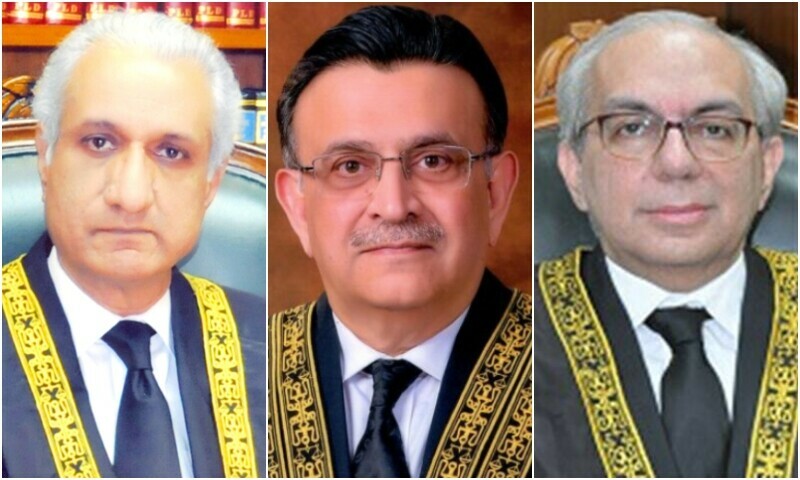
The Supreme Court of Pakistan’s three-judge bench convened on Wednesday to continue the hearing of the Election Commission of Pakistan’s (ECP) review petition regarding the April 4 verdict that set Elections for the Punjab Assembly will take place on May 14. Chaired by Chief Justice Umar Ata Bandial, the bench included Justice Ijazul Ahsan and Justice Muneeb Akhtar.
During the previous hearing, the apex court rejected the plea for an immediate suspension of the recently promulgated review of judgments law. Notices were issued to all parties involved, including the Pakistan Bar Council and the attorney general. The attorney general is expected to present the federal government’s stance on the review of judgments law.
In a surprising turn of events, lawyer Riaz Hanif Rahi, who had been missing for a few days, appeared before the court and requested his petition to be heard. The Chief Justice of Pakistan stated that the court would first hear arguments on the review petition. If the case against the review of judgments law is deemed weak, the court will determine the future course of action.
The ECP expressed its view that the petitions should be kept pending until a decision is reached regarding the plea against the law. The petitioner argued that the review law was in violation of Article 10 of the Constitution and interfered with the judiciary’s independence. They further contended that the objective of the practice and procedure, as well as the review laws, was the same.
During the proceedings, the court accepted the request of the Pakistan Tehreek-e-Insaf (PTI) to become a party to the case. Asserting that the Supreme Court has the power to review judgments, PTI’s attorney, Barrister Ali Zafar, cited Article 188, which made reference to a review. Zafar emphasized that there was a perception that the Supreme Court’s decisions were final, whereas the jurisdiction of a review cannot be equated to that of an appeal. He clarified that the purpose of a review was to ensure that there were no errors in the original verdict.
In response, the Chief Justice noted that Article 188 also addressed an act of parliament, and the Constitution did not mention anything about appealing against a Supreme Court decision. Zafar argued that the new law had granted reviews the same jurisdiction as appeals. The Chief Justice highlighted the significant difference between an appeal and a review, pointing out that the new law had merged both actions.
The ECP had filed a review petition in the Supreme Court, requesting a reconsideration of the court’s directives issued on April 4 regarding the setting of election dates in the country. In the 14-page petition, the ECP argued that the judiciary lacked the authority to determine election dates and that such powers were vested elsewhere in the Constitution. The ECP urged the court to review its decision and rectify the error of assuming the role of a public body in determining election dates.
Read More: Bushra Bibi Approaches LHC for Bail in a graft case filed in Islamabad
The ECP contended that the Supreme Court’s intervention was necessary to correct an error that had disrupted the settled constitutional jurisprudence of the country. The electoral body accused the apex court of overstepping its boundaries and assuming powers that did not belong to a court of law.
In the April 4 order, the bench nullified the ECP’s decision to postpone the provincial polls in Punjab from April 10 to October 8. The new date for the elections was established by the court as May 14. The court’s ruling also mandated the allocation of Rs21 billion by the federal government for the elections in Punjab and Khyber Pakhtunkhwa. Additionally, a comprehensive security plan was required to be provided to the ECP, emphasizing the importance of constant communication and updates throughout the process