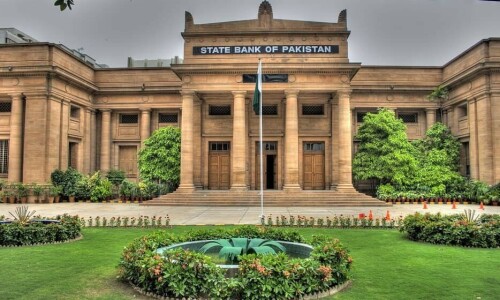
According to a press release published on Monday, the State Bank of Pakistan (SBP) has decided to hold the policy rate at 21 percent for the upcoming two months. The announcement follows a meeting of the bank’s Monetary Policy Committee (MPC) and reflects the assessment that inflation is likely to have peaked in May 2023. The decision takes into account several factors, including weak domestic demand, easing inflation expectations, declining global commodity prices, and the high base effect.
The SBP’s statement highlights that the MPC expects domestic demand to remain subdued amid a tight stance, ongoing domestic uncertainty, and external pressures on the country’s external account. Given the declining month-on-month trend, the committee anticipates that inflation has reached its peak at 38 percent in May 2023 and expects it to start falling from June onwards, barring any unforeseen developments.
The press release acknowledges significant developments since the last MPC meeting. Firstly, the provisional national accounts estimates indicate a considerable deceleration in real GDP growth during FY23. In addition, the current account balance experienced consecutive surpluses in March and April 2023, which eased some strain on foreign exchange reserves. Thirdly, on June 9 the administration unveiled the budget for FY24, which projects a slightly tighter budgetary outlook than the updated projections for FY23. Last but not least, the recent easing in global commodity prices and financial circumstances is anticipated to last for the foreseeable future.
The MPC is aware of the ongoing effects of the significant monetary tightening that has already been enacted. It considers the current monetary policy to be appropriate to stabilize inflation expectations and move inflation closer to the medium-term objective, with positive real interest rates on a forward-looking basis. However, the committee emphasizes that this outlook is contingent on effectively addressing the prevailing domestic uncertainty and external vulnerabilities.
The press release also sheds light on the performance of the country’s economy. The real GDP growth of 0.3 percent in FY23, compared to the revised FY22 growth of 6.1 percent, was primarily impacted by a significant contraction in the value addition of the industry due to adverse domestic and external factors. The services sector experienced its slowest pace of growth since the Covid-impacted FY20. The agriculture sector’s growth was lower than the previous year but better than post-flood expectations, driven by bumper sugarcane and wheat crops and robust growth in the livestock sector.
The MPC acknowledges the slowdown in economic activity as reflected in high-frequency indicators, including double-digit declines in auto and petroleum sales volumes, domestic cement sales, and contraction in large-scale manufacturing throughout the fiscal year. These trends are expected to continue in the near term due to the accumulated impact of tight policies. On the other hand, the agriculture sector is expected to perform better in the upcoming fiscal year, assuming no unfavorable weather conditions.
While the narrowing of the current account deficit has alleviated pressure on foreign exchange reserves and the interbank exchange rate, debt repayments, and weak investment inflows continue to exert pressure on reserves. The MPC stresses the importance of adhering to the target for the overall fiscal deficit to contain inflationary and external account pressures.
Read More: Govt to hire retired Army Officers in Islamabad Police
Looking ahead, the MPC expects reduced demand-side pressures, easing inflation expectations, moderating global commodity prices, and the high base effect to contribute to a decline in inflation from June 2023 onwards. It views maintaining the current policy stance as necessary to bring inflation down to the medium-term target range of 5-7 percent by the end of FY25.
Analysts indicate that the decision to keep the policy rate unchanged was largely expected, considering the easing inflationary pressures. They emphasize that Pakistan’s broader economic challenges, including upcoming debt repayments, continue to pose significant