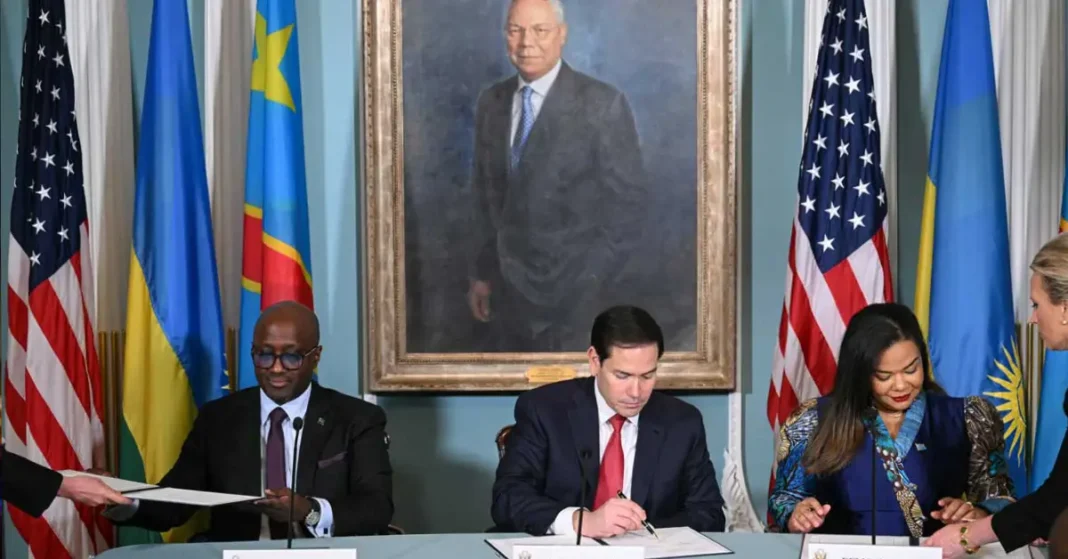
Trump brokers historic Rwanda-Congo peace deal, ending 30-year hostility
In a landmark diplomatic achievement, President Donald Trump on Thursday succeeded in brokering a historic peace agreement between Rwanda and the Democratic Republic of the Congo (DRC), effectively ending three decades of hostility between the two neighboring nations. The pact, formally known as the Washington Accord, was signed at the Donald Trump Institute of Peace in Washington, where Rwandan President Paul Kagame and Congolese President Félix Tshisekedi declared the end of long-standing tensions that have shaped the politics and security landscape of Central Africa for generations.
The signing ceremony followed a series of high-level meetings at the White House, where President Trump held both joint and separate discussions with the two leaders to finalize the terms of the agreement. Central to the pact is Rwanda’s commitment to halt any form of support for armed groups operating inside Congo, while both nations pledged to refrain from any military action against one another. The United States also announced fresh investment plans focusing on mineral exploration, infrastructure development, and joint economic ventures in both countries, aiming to spark long-term regional stability and prosperity.
President Trump, speaking at the ceremony, framed the accord as a major global milestone. “Today, the world has seen another major conflict resolved,” he said. “This agreement opens the door to peace, prosperity and opportunity for the people of Rwanda and Congo.” His remarks were echoed by President Kagame, who acknowledged that while numerous nations had attempted to mediate in the past, none had succeeded in bridging the divide. “For 30 years, no one was able to end this conflict,” Kagame emphasised. “President Donald Trump played a neutral and decisive role in helping us achieve peace. If this agreement fails, the responsibility will be ours — not his.”
President Tshisekedi voiced similar optimism, saying the Washington Accord would usher in a new era of cooperation and stability across the Great Lakes region. “We have signed this peace agreement for the future of our people,” he said. “I thank President Donald Trump and his administration for their support. This accord will lead to greater stability and prosperity throughout the region.” His comments reflect growing regional hope that the deal could finally break the cycle of violence that has displaced millions, fueled militia activity, and triggered recurrent humanitarian crises for decades.
The historic agreement carries enormous implications for regional security. Armed groups have operated for years in eastern Congo, exploiting mineral-rich territories and often receiving foreign backing. Under the accord, joint security teams supported by international observers will monitor borders, restrict militia activities, and oversee disarmament programs. This marks the first coordinated security mechanism between the two nations in decades. Leaders and diplomats attending the ceremony hailed the move as a turning point, calling it a rare moment of unity in a region long defined by mistrust and conflict.
The economic dimension of the pact is equally significant. The DRC holds some of the world’s largest deposits of cobalt, coltan, gold, and copper — resources essential to global industries, including technology, energy, and manufacturing. For years, conflict-driven mining operations and illegal exploitation by armed factions have robbed citizens of economic benefits while enriching warlords and fueling instability. Under the Washington Accord, the U.S. will support regulated mining operations, infrastructure development, and long-term investment initiatives designed to channel profits toward community development, job creation, and national growth. For Rwanda and Congo, these investments could mark the beginning of a new economic era.
Despite the optimism, the road ahead remains challenging. Decades of mistrust between the two nations cannot disappear overnight. Implementation of the agreement will require consistent political will, transparency, and strong monitoring institutions. Local rebel factions, criminal networks, and political spoilers may attempt to derail progress. Leadership changes, internal power struggles, or regional interference could also pose risks. Analysts note that while the Washington Accord is historic, its success hinges on sustained commitment from both nations and the international community.
Even so, the human impact of this breakthrough is profound. Communities shattered by conflict may finally see families return home, schools reopen, businesses revive, and roads rebuilt. The possibility of normal life returning to eastern Congo — an area long trapped in cycles of violence — offers hope to millions who have never experienced lasting peace. In Rwanda, renewed stability could further cement economic growth and regional integration efforts already under way, as a development widely discussed across global diplomatic circles and international media coverage..
Many observers believe that the Washington Accord could become a global model for conflict resolution, demonstrating how neutral mediation, balanced diplomacy, and economic incentives can create lasting peace. International reactions so far have been overwhelmingly positive, with leaders from across Africa and global institutions praising the accord as a “monumental step forward.”
As implementation begins, all eyes now turn to how Rwanda and Congo turn promises into action. The next months will be critical. If the commitments are honored and reforms take root, the Washington Accord could write a new chapter in Central Africa’s history — one driven not by hostility, but by cooperation, development, and shared progress.