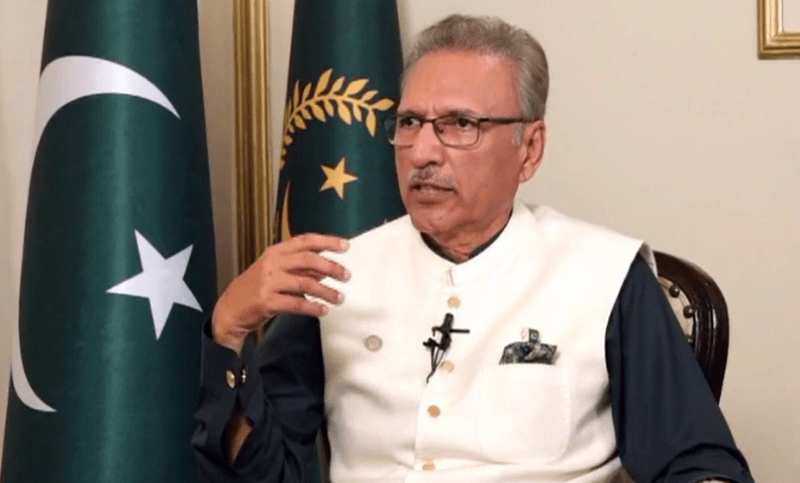
- The President says the bill apparently is beyond the competence of the parliament and sending it back for review looks appropriate.
Islamabad: President Dr. Arif Alvi refused to sign the Supreme Court (Practice and Procedure) clipping the powers of the Chief Justice of Pakistan, saying that “prima facie, the bill is beyond the competence of the parliament”.
The President said that returning bill to the parliament for its reconsideration was appropriate as per the provisions of the Article 75 of the Constitution
Both the houses of the parliament last week approved the bill and sent it to the president for assent amid a deepening the political and constitutional crisis in the country over elections in Punjab and Khyber Pakhtunkhwa.
The President said that returning bill to the parliament for its review was appropriate.
Last week, the president started consultation with the Presidency’s legal team as well as the Ministry over approval of the Supreme Court (Practice and Procedure) Bill passed by the parliament to clip the powers of the Chief Justice of Pakistan.
They said that the President sought suggestions from the legal team of Presidency and Law Ministry.
The bill would be tabled in a joint sitting of the parliament if the president refused to approve.
The parliament approved the Supreme Court (Practice and Procedure) Bill 2023, which sought to limit the chief justice of Pakistan’s ability to take suo motu notice in a personal capacity.
The bill was presented by Federal Minister for Law and Justice, Azam Nazeer Tarar, and was passed soon after the Standing Committee on Law and Justice gave the green light to the proposed amendments made by the cabinet.
The Defense Minister had expressed his belief that the Supreme Court’s structure should be democratized. He emphasized the importance of strong laws and procedures without any trespassing. He also expressed his opinion that legislation regarding former prime ministers should be a priority and should have been done long before.
Regarding the prevailing political crisis, the Defense Minister stated that the judiciary and establishment are both important components, and he had made attempts to initiate dialogue with all stakeholders, but no progress had been made so far. He expressed doubts that talks among PTI leaders would lead to any fruitful outcomes.
The Defense Minister stressed the need for purposeful negotiations and emphasized that all stakeholders in the political system must come together with a clear agenda to tackle the current conundrum. He also mentioned that the coalition government had held talks with PTI representatives in the past two months, but they did not come prepared with any agenda or seriousness.
At the end, the Defense Minister said that he believed that purposeful negotiations are necessary to resolve the current political crisis, and the Supreme Court’s structure should be democratized with legislation regarding former prime ministers as a priority.