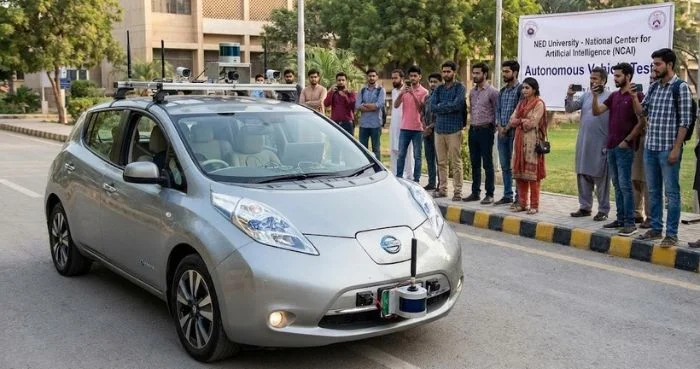
Pakistan unveils first AI-powered driverless car at NED University
Pakistan has marked a major technological breakthrough with the successful testing of its first AI-powered driverless car at the NED University of Engineering and Technology in Karachi.
The autonomous vehicle was developed under the National Center for Artificial Intelligence (NCAI) at NED University and recently completed a successful road trial on the university campus. The test attracted keen interest from students, researchers and faculty members, highlighting growing enthusiasm for artificial intelligence and automation in Pakistan.
The Pakistan AI-powered driverless car project was initiated nearly a year ago and has now entered its practical implementation phase following extensive research and development. The prototype is based on an electric vehicle imported from China, which was transformed into a fully autonomous system using advanced robotics, digital mapping technology, LIDAR sensors and computer vision algorithms.
According to researchers involved in the project, the vehicle operates without any human intervention. Its steering and navigation systems rely on radar-based sensing and AI-driven vision technologies to detect obstacles, assess road conditions and respond to its surroundings in real time.
For safety purposes, the vehicle’s speed is currently limited to between 15 and 20 kilometres per hour. Engineers said the restriction allows the team to fine-tune performance while ensuring controlled testing conditions.
The autonomous car has been specifically designed to handle Pakistan’s complex urban traffic environment. Its sensor network enables it to navigate common road challenges such as potholes, uneven surfaces and unpredictable traffic patterns, making it more suitable for local conditions compared to imported autonomous systems.
NED University researchers said ongoing work is focused on enhancing the car’s capabilities, including object and pedestrian detection, lane recognition, speed regulation and traffic signal identification. Future phases of the project aim to improve accuracy, safety and real-world usability.
Experts have described the successful testing as a significant step forward for Pakistan’s technology sector, opening doors for innovation in smart transportation, artificial intelligence research and sustainable mobility solutions.
The achievement also reflects Pakistan’s growing investment in AI-driven research and its potential to contribute to global advancements in autonomous vehicle technology.