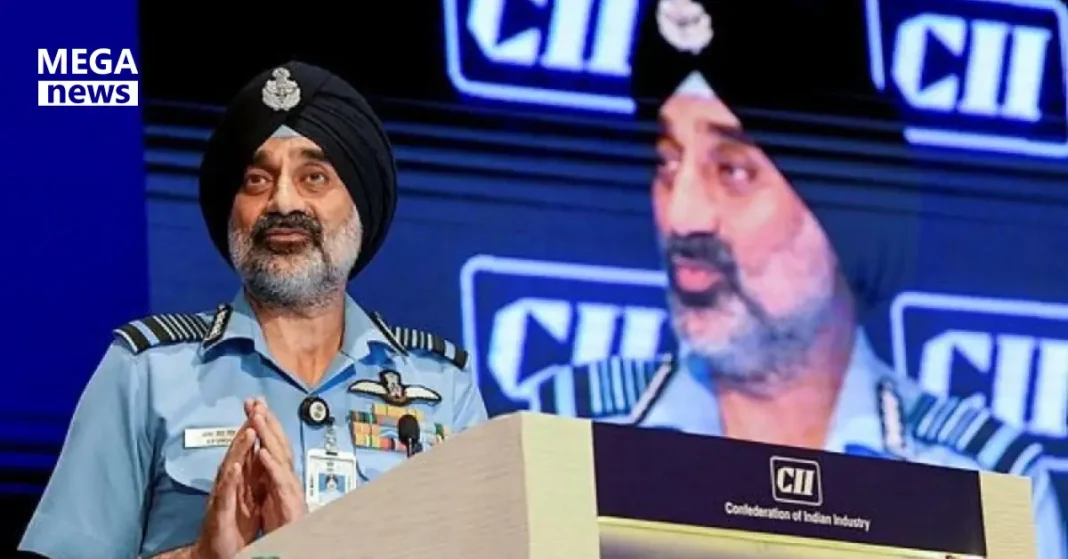
Indian Air Force Chief Claims to Have Shot Down Six Pakistani Aircraft:
Indian Air Force Chief AP Singh claims to have shot down six Pakistani aircraft during the four-day conflict between the two countries in May, marking the first time an Indian official has made such a statement since the fighting ended. Speaking at a press conference, Singh detailed what he called “Operation Sindoor,” asserting that Indian forces achieved at least five confirmed fighter kills and one large aircraft kill, which he described as either an ELINT or an AEW&C aircraft taken at a range of around 300 kilometres. He claimed this engagement was “the largest ever recorded surface-to-air kill” by India.
The remarks come three months after the conflict, during which the Indian military faced significant embarrassment on the global stage over its heavy losses at the hands of Pakistan. Until now, no Indian official had claimed comparable damage inflicted on Pakistan’s military assets. In contrast, several international media outlets and even US President Donald Trump had confirmed that Pakistan shot down Indian fighter jets before any such claim emerged from New Delhi.
READ MORE: India Pakistan Hostilities 2025: Trump Claims Five Jets Were Shot Down Before Ceasefire
No independent or international outlet has verified India’s claim of downing six Pakistani aircraft. Indian officials, however, have repeatedly acknowledged in various briefings and media appearances that Pakistan successfully targeted Indian Rafale jets during the conflict. The Indian government publicly confirmed the deaths of its personnel, awarding posthumous honours to several soldiers, including four pilots—three of whom were flying Rafale jets when they were lost.
Indian Defence Attache Captain Shiv Kumar openly admitted that the Indian Air Force lost aircraft on the night of what he described as unprovoked Indian strikes on civilian areas inside Pakistan. Similarly, India’s Chief of Defence Staff General Anil Chauhan acknowledged to Bloomberg that Pakistani forces downed Indian aircraft, though he avoided providing exact figures. When pressed, he shifted the discussion to tactical lessons learned, stating, “The jet being downed is not important, but why it was downed. The good part is that we identified the mistake, corrected it, and later flew our jets again with long-range targeting.”
The conflict’s roots trace back to April, when a deadly attack in Pahalgam, Indian-occupied Kashmir, killed 26 people. India immediately blamed Pakistan but offered no evidence to support its accusation. Pakistan denied any involvement and proposed full cooperation in an independent investigation. The United States condemned the attack but notably refrained from endorsing India’s claims against Pakistan.
On May 7, tensions erupted into open conflict as India launched strikes inside Pakistan. Islamabad responded with force, shooting down five Indian aircraft, including advanced Rafale fighters, according to Pakistani sources. India has yet to confirm these specific losses. The confrontation escalated quickly, involving fighter jets, drones, and heavy artillery, and caused significant Indian casualties.
The situation de-escalated after India sought US mediation, with President Trump later claiming credit for brokering a ceasefire. He stated that his intervention, which included direct warnings to both nations about potential trade consequences, led to a truce on May 10. Despite this, the new claim by AP Singh has reignited debate over the actual scale of losses suffered by both sides, with analysts noting that without independent verification, the truth behind “Operation Sindoor” remains uncertain.