PM Shehbaz Takes Charge at NSC Meeting as Political Upheaval Rocks Pakistan
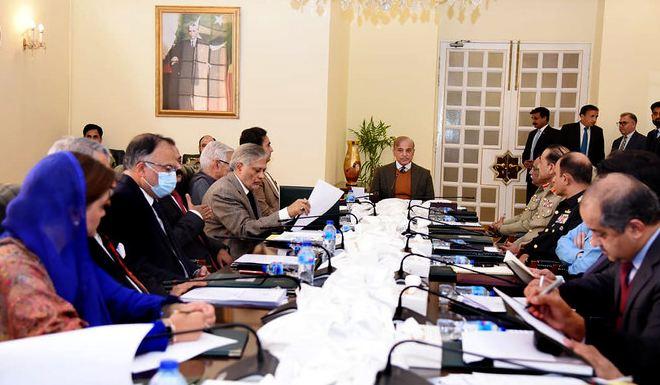
The National Security Committee (NSC) meeting, chaired by Prime Minister Shehbaz Sharif, was held today to discuss pressing security issues and heightened political tensions between the government and its rival political parties, particularly the Pakistan Tehreek-e-Insaf (PTI).
The two-hour meeting of the committee, which acts as the principal decision-making body on national security matters, has ended. The NSC meeting was attended by senior civil and military leadership.
A statement, which typically follows such meetings, has yet to be released. However, Dawn’s report quoted insiders as saying that the government would once again ask the top brass for a briefing on potential threats from militants in case elections were held in Punjab on May 14, as per the Supreme Court’s order.
Pakistan Army refuses poll-related duties due to security concerns: the possibility of imposing emergency discussed
The Pakistani Army recently informed the Election Commission of Pakistan that its troops will not be available to assist with election-related duties due to the current security situation within the country and on its borders. The army stated that it views its primary duties as securing the nation’s borders and ensuring its safety, with election duty being secondary.
According to the report, military authorities briefed the government on the fact that terrorist groups have re-established themselves in tribal districts that border Afghanistan, making electioneering under current circumstances difficult.
In light of these circumstances, the option of “imposing an emergency” in the country was discussed at the recent National Security Council (NSC) meeting. Such an emergency can be declared under Article 232 of the Constitution for up to one year due to war or internal unrest. However, the parliament must pass a resolution to declare an emergency. The last NSC meeting in January 2023 reiterated the government’s commitment to a “zero tolerance” policy against terrorism in the country.
PTI leader Shireen Mazari has stated that the NSC meeting would be crucial and would significantly impact the nation’s security’s future course of action.
She expressed concerns that the opposition party, the Pakistan Democratic Movement (PDM), might translate their fear of elections into the state turning against the nation. She added that she hopes this would not happen.
The NSC meeting, which comes at a time when political tensions are running high, has been closely watched by political analysts and observers.
The government’s request for a briefing on potential threats from militants in case elections are held in Punjab on May 14 is a clear indication of the concerns surrounding the security situation in the country.
Moreover, the option of imposing an emergency in the country raises serious questions about the state of democracy in Pakistan. The declaration of an emergency could be seen as a step towards authoritarianism and could lead to the curtailment of civil liberties and fundamental rights.
The PTI’s concerns about the government’s vendetta against the party and its leader, Imran Khan, have also been a major point of contention in recent months. The government’s crackdown on the opposition and the media has raised concerns about the state of democracy in the country and the government’s commitment to upholding the rule of law.
The NSC meeting, therefore, has the potential to shape the future of Pakistan’s security and democracy. It is important that the government takes into account the concerns of all stakeholders and ensures that any decisions taken are in the best interests of the country and its people.
Despite the clear benefits of holding a free and fair election, there are still concerns that the current security situation in Pakistan may pose a risk to the safety of voters and election officials. The Taliban and other extremist groups have long sought to disrupt the democratic process in Pakistan through violence and intimidation, and there are fears that they could ramp up their attacks in the run-up to the election.
While the military has traditionally been involved in providing security during elections in Pakistan, this year’s election is expected to be particularly challenging due to the increased threat posed by extremist groups. As a result, the NSC meeting was focused on developing a comprehensive security plan that would ensure the safety of voters, election officials, and candidates.
The NSC also discussed the possibility of imposing an emergency in the country, which would give the government additional powers to address security concerns. However, such a move is seen as a last resort and would require the support of parliament to be implemented.
Overall, the NSC meeting was a critical step in ensuring the safety and integrity of Pakistan’s upcoming election. By bringing together key leaders from both the civil and military sectors, the government is demonstrating its commitment to holding a free and fair election, even in the face of significant security challenges.
Read More: In Senate, Sherry Rehman affirms that India cannot modify the Indus Water Treaty alone
As the election draws closer, it will be important for all political parties to work together to ensure that the democratic process is upheld and that the rights of all voters are protected. With the support of the government and the military, Pakistan can move forward with confidence and hold an election that truly represents the will of its people.