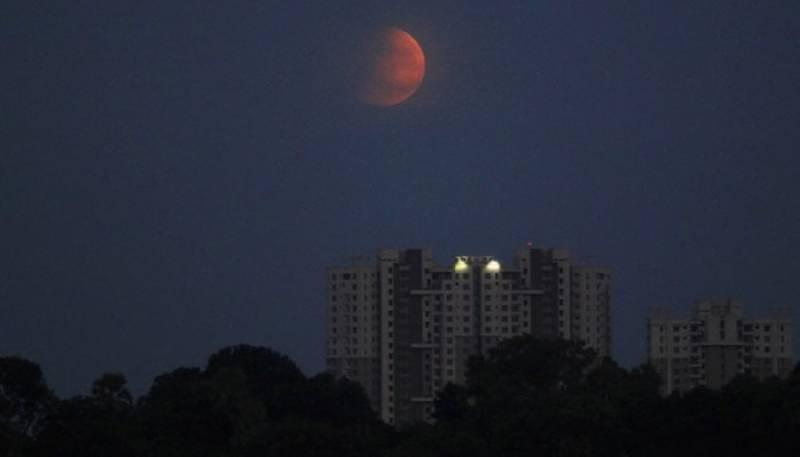
On the night of May 5 and 6, sky watchers can witness the first penumbral lunar eclipse of 2023, a natural occurrence where the moon is covered by the Earth’s lighter or outermost shadow. This phenomenon is typically difficult to observe and takes place during a full moon when the Earth is positioned between the sun and the moon, casting a shadow on the moon’s surface.
Like other parts of the world, the eclipse will be visible in Pakistan. It will also be visible in Asia, Australia, South/East Europe, Africa, Atlantic, Pacific, Indian Ocean, and Antarctica.
According to the Pakistan Meteorological Department (PMD), the lunar eclipse will commence at 8:14 pm and conclude at 12:32 am, with different stages occurring between these times. Space enthusiasts worldwide are looking forward to the event, which will be visible across several parts of the globe.
The next eclipse is expected to be visible in parts of America, Africa, Asia, Europe, and Australia on October 28. The last total lunar eclipse occurred on November 8, 2022, and the upcoming total lunar eclipse, also known as a blood moon lunar eclipse, will occur on March 13-14, 2025.
It is worth noting that lunar eclipses come in three types, depending on the Sun, Earth, and moon’s alignment. During a total lunar eclipse, the Earth’s shadow covers the entire lunar surface, while during a partial lunar eclipse, only a part of the moon is shadowed, appearing to have a “bite” taken out of it. A penumbral lunar eclipse occurs when the Earth’s faint outer shadow falls on the moon’s surface.
Solar eclipses in 2023
The year’s first solar eclipse was witnessed in many parts of the world, but unfortunately, it was not visible in Pakistan on April 20. The phenomenon began at 6:34 am local time and peaked at 9:17 am, according to the Meteorological Department. The eclipse ended at 11:59 am. Several countries across South East Asia, Australia, the Indian and Pacific Ocean regions, as well as Antarctica, are reportedly experiencing the phenomenon.
Read more: Gold price hits new high of Rs222,700 per tola in Pakistan
According to Meteorological Department there would be four eclipses this year, which includes two lunar and solar each. While the solar eclipse is a breathtaking event, it can also be used by scientists to study the sun’s corona, which is usually obscured by its bright rays.